Species profile
European Robin
Erithacus rubecula rubecula · (Linnaeus, 1758)
· Updated 30 March 2024
Recommended birdwatching tours to watch this bird
Half-day birdwatching
Full-day birdwatching
European Robin Field ID Keys
Shape & Size
A medium-sized chat with short bill and short legs
Colour Pattern
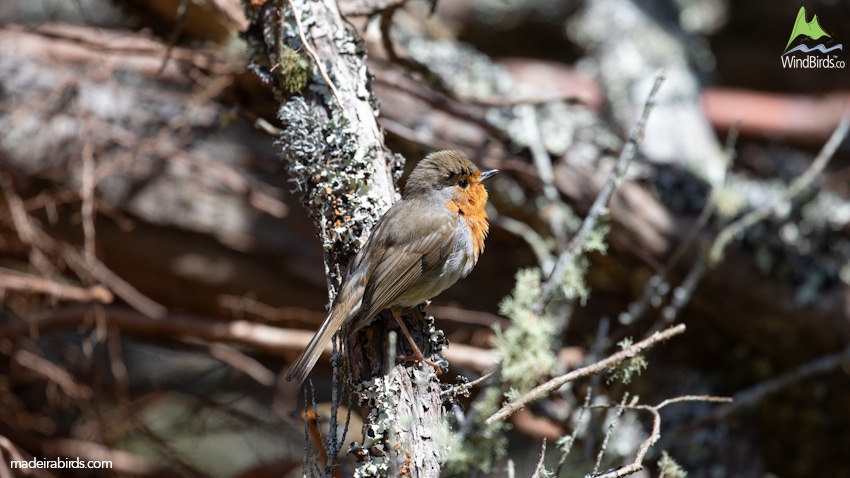
Robin has olive-brown upper-parts, orange face and breast and olive-buff underside. Its bill and eyes are black and legs are brown.
Behavior
In Madeira, Robins are not so tame as in Europe. Their singing can be heard from trees which is normally the way to spot them. It is usually aggressive towards other individuals. Its flight is normally short, low and flitting into cover.
Habitat
It is a widespread species through Europe though absent from Iceland. It occurs in a wide variety of forests, woodlands and gardens.
Distinction from similar species
Only a juvenile Robin could be mistaken with other chats. Adults Robin is very distinct from other European birds.
Erithacus rubecula Biometrics
Wingspan: 20 - 22 cm (Hume, 2002)
Total length: 14 cm (Beaman & Madge, 2011)
Weight: 16 - 22 g (Hume, 2002)
Other Bird Facts
Seasonality in Madeira: All year
Breeding: Builds its nest in dense bush or hedge where it lays 4 to 6 eggs in each of 2 broods between April and August
Diet: Feeds mainly on spiders, insects, worms, berries and seeds from the ground
Status
Madeira local status by Correia-Fagundes et al, 2021: Common breeding bird
Madeira local status by Romano et al, 2010: Common breeding bird
Madeira local status by Zino et al, 1995: Common breeding bird
Conservation status by the IUCN Red List Categories, 2013: Least Concern ver 3.1
Name of this species in other languages
Madeiran: Papinho
Portuguese: Pisco-de-peito-ruivo
German: Rotkehlchen
Dutch: Roodborst
Swedish: Rödhake
Danish: Rødhals
Finish: Punarinta
Norwegian: Rødstrupe
Spanish: Petirrojo Europeo
French: Rougegorge familier, Rougegorge
Italian: Pettirosso europeo
Polish: Rudzik
Slovak: červienka obyčajná
Czech: červenka obecná
English synonyms: Robin