Madeira Island Flora
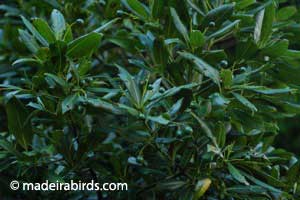
Canary Laurel Apollonias barbujana
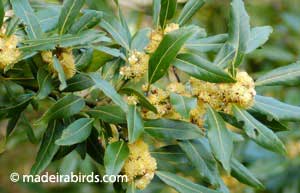
Bay Laurel Laurus novocanariensis
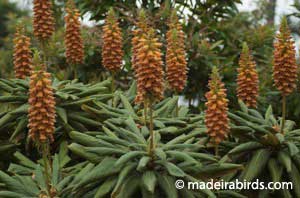
Isoplexis Isoplexis sceptrum
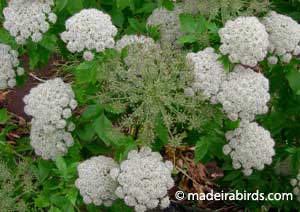
Black Parsley Melanoselinum decipiens
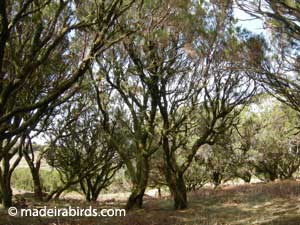
Broom Heather Erica scoparia
ZAMBUJAL - from sea level to 300 meters in the South and to 100 meters in the North coast
This is an arboreal climatic community dominated by the Wild Olive Tree Olea maderensis an endemic specie of Madeira that inhabits the coastal cliffs, associate to another endemic shrub Chamaemeles coriacea of our archipelago whose conservation status is determined as in immediate danger.
In the herbaceous-shrub stratus we find other endemics as White Everlasting Helichrysum melaleucum, that has aromatic and medicinal properties and the Golden Musschia Musschia aurea whose yellow-golden flowers, with a bell shape, cheer the landscapes of Madeira and Desertas Islands, as well as some species with a high scientific interest, due to their threat of extinction, as the Andryala Andryala crithmifolia, the White Madeira Jasmine Jasminum azoricum and the Stonecrop Aichryson dumosum.
LAURISSILVA DO BARBUSANO - from 300 to 800 meters in the South and from 100 to 400 meters in the North
This forest is a Madeira endemic community dominated by two laurels: the Canary Laurel Apollonias barbujana and the Bay Laurel Tree Laurus novocanariensis, even so is associated with other species as the Iron Wood Sidenoxylon marmulano var. marmulano and the Canary Holly Ilex canariensis var. canariensis - not so frequent Macaronesia endemic species.
This forest has one raised wealth of endemic woody liana and climbing plants from Macaronesia and others from Madeira of which we emphasize the Smilax aspera, Canary Bindweed Smilax canariensis, the Edible Bryony Tamus edulis and the rare Madeira Bindweed Convolvulus massonii that is in immediate danger.
LAURISSILVA DO TIL - from 800 meters to 1450 meters in the South and from 400 to 1400 meters in the North
- On this step there is a subdivision of the species:
- A kind of a riparian forest associated to water courses and dominated by Madeira Mahogany Persea indica, Salix canariensis and Bay Laurel Tree Laurus novocanariensis. In the shrub stratus predominates the Madeira Elder Sambucus lanceolata, the Bastard Hare's Ear Phyllis nobla and the Large-Leaved Saint John's Wort Hypericum grandifolium. At the herbaceous level the prominence goes for the ferns, as the Chain Fern Woodwaria radicans, the Diplazium caudatum and the Pteris incompleta, and still for some Madeira's endemic spermatophytes as the Festuca donax, Parafestuca albida and the Madeira Moneywort Sibthorpia peregrina. Two of the most beautiful plants that we can find in this community are the Madeira Orchid Dactylorhiza foliosa and the Madeira Squill Scilla maderensis var. maderensis.
- Part of an arboreal climatic community, dominated by Fetid Laurel Ocotea foetens, Bay Laurel Tree Laurus novocanariensis and Lily-of-the-Vally tree Clethra arborea. Here it is also possible to find the Beefwood Heberdenia excelsa, the Madeira Holly Ilex perado and still the rare Madeira Cheese Wood Pittosporum coriaceum that is in immediate danger. In the shrub level we point out the presence of the endemics like the Madeira Blueberry Vaccinium padifolium, the Isoplexis (or Yellow Fox Glove) Isoplexis sceptrum and the Shrubby Sow Thistle Sonchus fruticosos. In the herbaceous plants group the prominence goes for the Madeira Stork's Bill Geranium maderensis, a plant with pink flowers that inhabits the high places of the Laurel Forest and wet places of the central mountainous massif of Madeira Island.
URZAL DE ALTITUDE - higher than 1400 meters
The higher altitudes of Madeira are in the central mountainous massif. In these places we can find an endemic community dominated by Tree Heather Erica arborea and Besom Heather Erica platycodon ssp. maderensis species whose ecological niche is to capture water from the mist by condensation.
In this community some endemic species such as Madeira Blueberry Vaccinium padifolium, Madeira Mountain Ash Sorbus maderensis and Madeira Heather Erica maderensis are frequent.
The great treasure of this habitat is the set of herbaceous plants that bewitches all the ones that contemplate these precious. From this group we distinguish the rare Madeira Thrift Armeria maderensis, Madeira Violet Viola paradoxa - a rarity with shining yellow flowers that lives "hidden" in inaccessible rocky cliffs, Madeira Kidney Anthyllis lemanniana and the Rock Orchid Orchis scopolorum that inhabits the high rocky cliffs.