Spanish Sparrow Passer hispaniolensis (Temminck, 1820)
Order: Passeriformes Family: Passeridae Status: Breeding in Madeira
Recommended birdwatching tours to watch this bird
Spanish Sparrow Field ID Keys
Shape & Size
A medium-sized sparrow with strong bill and short legs.
Colour Pattern
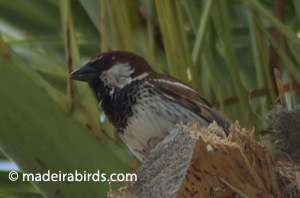
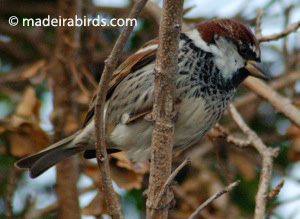
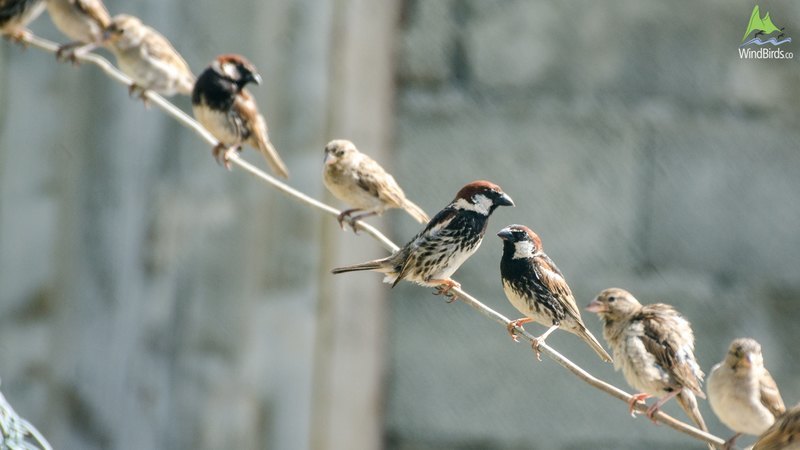
A species with an accentuated sexual dimorphism. Males have a brown-reddish cap, a white stripe over the eye, black throat and chest gradually extending into patterned belly and flanks. Its cheeks are white as well as its undersides with some white stripes on its rufous-brown back. Females are lighter and more uniformly grey-brown, with a striped flank, darker wings and a beige supercilium stripe.
Behavior
This is a very sociable species found in large flocks and breeding colonially in avenues of trees, making loud chirruping.
Its flight is quick, low and whirring with some momentary closure of wings.
Habitat
The distribution of this species covers the Mediterranean and Canary Islands. It used to be very abundant on Madeira, but its population has diminished drastically on the island being found only in Caniçal village until 2018 and is now extinct in Madeira, though it is still quite common in Porto Santo.
Some authors say this species arrived naturally in Madeira in 1935 and established as a breeding bird, using the habitats made available in urban areas, such as gardens and public squares with palm trees.
Distinction from similar species
Spanish Sparrow can be mistaken by a Tree Sparrow (never recorded in Madeira archipelago) being its main distinctive features its white cheeks and streaked underparts instead of the black cheek spot and unmarked grey-buff undersides of the Tree Sparrow.
Passer hispaniolensis Biometrics
Wingspan: 20 - 22 cm (Hume, 2002)
Total length: 14 - 16 cm (Svensson et al, 2009)
Weight: 20 - 25 g (Hume, 2002)
Other Bird Facts
Seasonality in Madeira: All year
Breeding: Makes holes in the trunks of Canary Palm trees Phoenix canariensis. where it lays 3 to 7 eggs on up to 3 broods between April and July.
Diet: Eats seeds and berries and feeds insects to its chicks.
Status
Madeira local status by Correia-Fagundes et al, 2021: Occasional
Madeira local status by Correia-Fagundes et al, 2021: Rare breeding bird
Madeira local status by Romano et al, 2010: Rare breeding bird
Madeira local status by Zino et al, 1995: Rare breeding bird
Conservation status by the IUCN Red List Categories, 2013: Least Concern ver 3.1
Name of this species in other languages
Portuguese: Pardal espanhol
German: Weidensperling
Dutch: Spaanse Mus
Swedish: Spansk sparv
Danish: Spansk Spurv
Finish: Pensasvarpunen
Norwegian: Middelhavsspurv
Spanish: Gorrión Moruno
French: Moineau espagnol
Italian: Passero spagnolo
Polish: Wróbel sródziemnomorski
Slovak: Vrabec obojkový
Czech: Vrabec pokřovní
English synonyms: Willow Sparrow