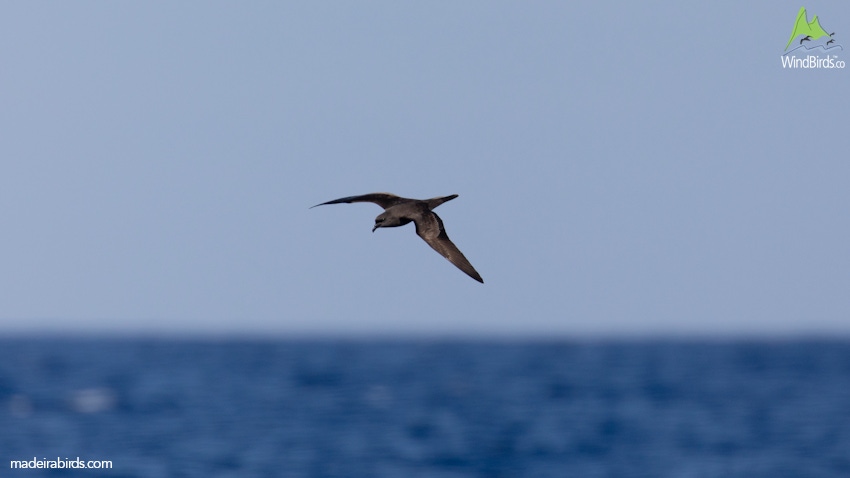
Bulwer's Petrel Bulweria bulwerii (Jardine & Selby, 1828)
Order: Procellariiformes Family: Procellariidae Status: Breeding in Madeira
Recommended birdwatching sea trips to watch this seabird
Bird, dolphin and whale watching trip
Zino’s Petrel Pelagic Expedition
Bulwer's Petrels Field ID Keys
Shape & Size
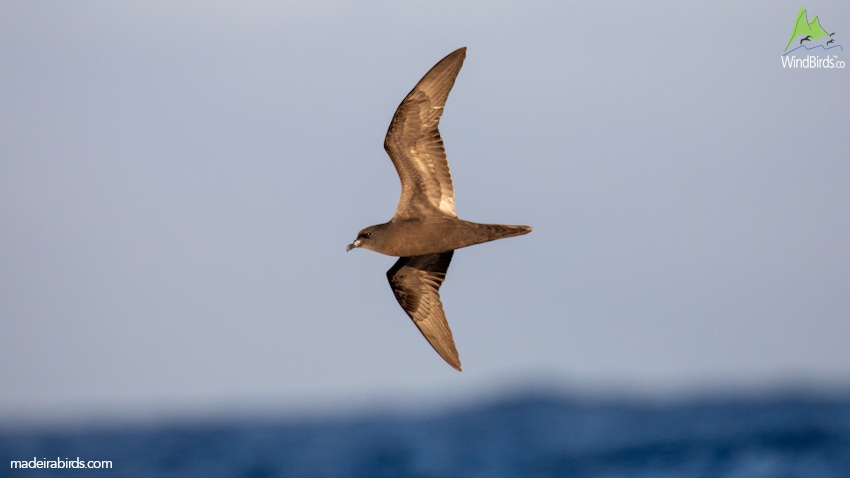
A small petrel with a slim body, large wingspan proportionally to the body, pointed wings and a long tail. There is no clear sexual dimorphism, despite bill and tarsus being longer in males.

Colour Pattern
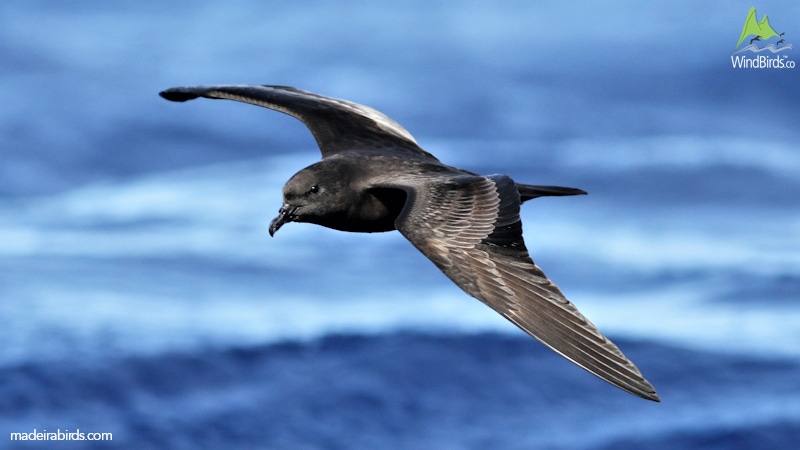
This is a uniformly dark seabird with a blackish-brown colour.

Behavior
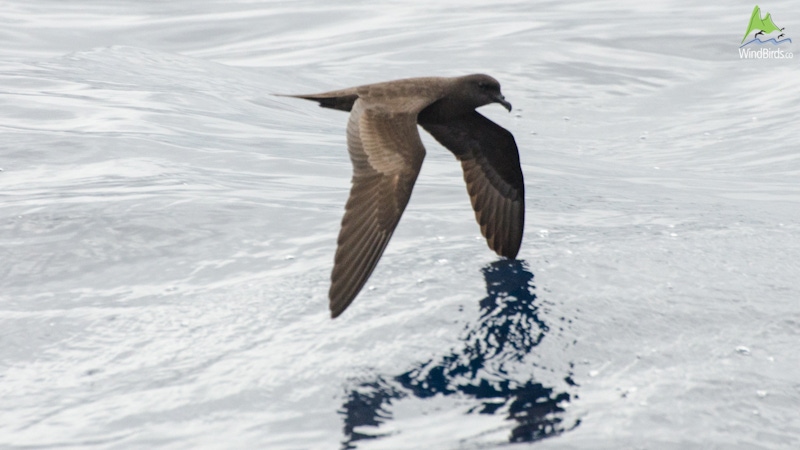
Bulwer’s petrel flight is usually not high from seawater, especially on strong winds and it flies alone or in pairs. It is not commonly seen in feeding frenzies with cetaceans though it is normally attracted to chum.
Habitat
This seabird is a species of tropical and subtropical waters, ranging from 10º S to 40º N, in Northeast Atlantic, Pacific and Indian Oceans. In the Atlantic it breeds on the Canary Islands, all Madeira archipelago islands and on some islets of Cape Verde and Azores.
Distinction from similar species
As normally there is no other all-dark petrel or shearwater in the North Atlantic, the only species it might be confused with is the rarely seen Swinhoe’s storm petrel though Bulwer’s Petrel is bigger and with a long and not forked tail.

Bulweria bulwerii Biometrics
Wingspan: 670 mm (Flood & Ashley, 2011)
Total length: 260 - 280 mm (Flood & Ashley, 2011)
Weight: 100 - 110 g (Flood & Ashley, 2011)
Other Bird Facts
Seasonality in Madeira: From mid April to end of September
Breeding: Nests are usually natural holes in the ground or cliffs, not excavated where 1 egg is laid between late May and mid June with fledging occurring in September.
Diet: They feed on small fish on the surface
Status
Madeira local status by Correia-Fagundes et al, 2021: Very common breeding bird
Madeira local status by Romano et al, 2010: Very common breeding bird
Madeira local status by Zino et al, 1995: Very common breeding bird
Conservation status by the IUCN Red List Categories, 2013: Least Concern ver 3.1
Name of this species in other languages
Portuguese: Alma-negra
German: Bulwersturmvogel
Dutch: Bulwers Stormvogel
Swedish: Spetsstjärtad petrell
Danish: Bulwers Petrel
Finish: Tyrskyliitäjä
Norwegian: Spisshalepetrell
Spanish: Petrel de Bulwer
French: Pétrel de Bulwer
Italian: Procellaria di Bulwer
Polish: Tajfunnik cienkodzioby
Slovak: Víchrovec klinochvostý
Czech: Buřňák Bulwerův
Join Madeira Wildlife Monthly Newsletter. All the updates on your email every month.